
Scientific interest
Across four frontiers—high-temperature superconductivity, magnetic topological materials, chiral correlated phases, and novel ordering/disordering—we combine scattering spectroscopy (neutron, X-ray, symmetry-resolved Raman, etc.) with high-quality single crystals to find microscopic explanations for macroscopic phenomena. The common thread is extracting key degrees of freedom and couplings, so theoretical ideas can be rigorously tested.
a) Mechanism of high-temperature superconductivity
We pursue a quantitative understanding of pairing in cuprate, iron-based superconductors and beyond. Which microscopic interactions set the energy scales that track Tc—superexchange, electron–phonon coupling, orbital hybridization, or their cooperation? Can we identify “material genes” in the lattice and electronic structures that are linked to pairing strength and symmetry? By combining high-quality single crystals with precision scattering probes, we map collective excitations and their coupling to the charge carriers, aiming for a testable framework that ties spectroscopic observables to the pairing glue.

b) Magnetic topological materials

We study magnets where nontrivial band topology intertwines with electron correlations and itinerancy. How do electron interactions, spin–orbit coupling, and covalency shape magnon/electron bands—producing topological magnons and/or unconventional spin degrees of freedom in crystals? We develop spectroscopy workflows and join forces with theorists to make concrete progress on this exciting frontier.
c) Chiral correlated electronic phases
Chirality—structural or electronic—can enable novel material properties. Where does chirality originate: lattice handedness, noncollinear spin textures, or spontaneous charge ordering? What observables—circular-dichroic optical/Raman/X-ray responses, nonreciprocal transport, gyrotropic thermodynamics—diagnose chiral order most cleanly? We use symmetry-resolved spectroscopy under external fields and low temperatures to search for chiral correlated phases and track their microscopic behaviors.
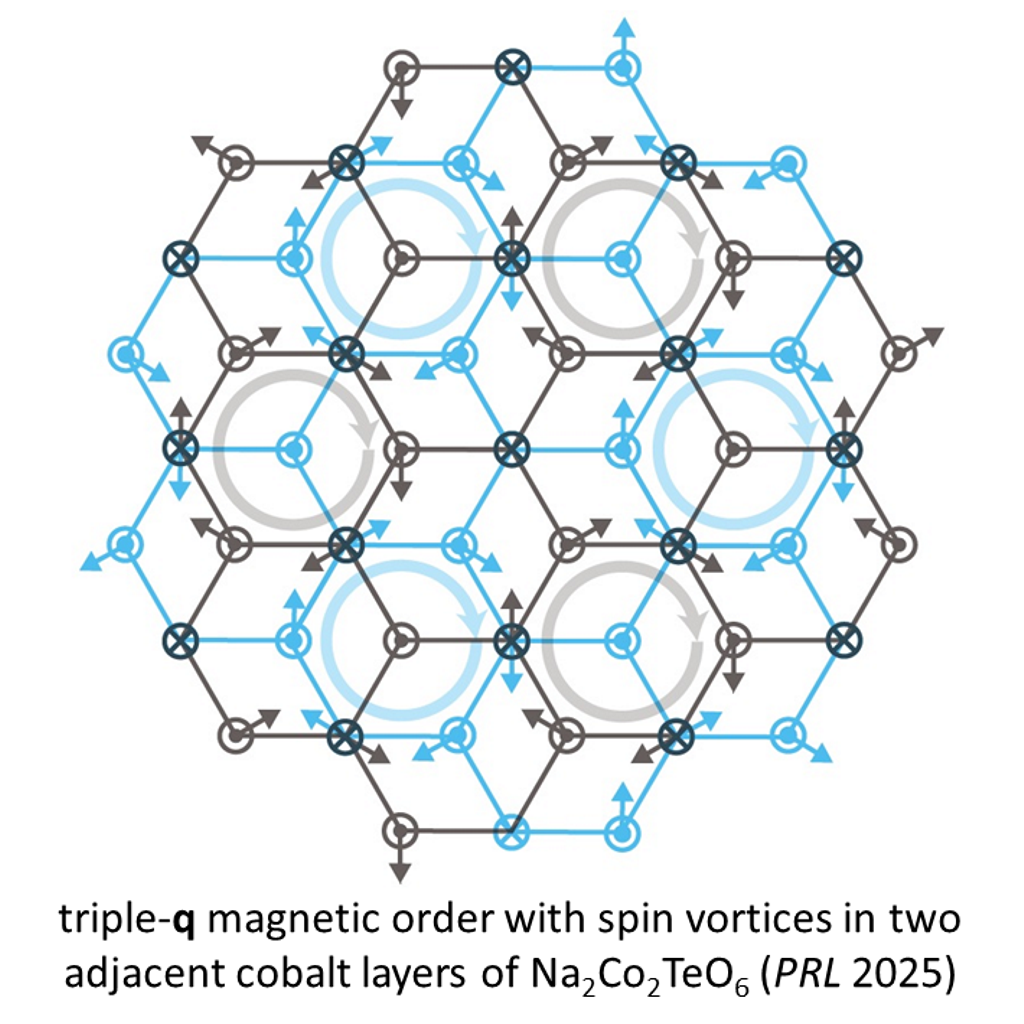
d) Novel ordering / disordering phenomena

Beyond conventional broken-symmetry phases, we examine quantum spin liquids, multipolar order, and states formed by the condensation of unconventional excitations. Which minimal Hamiltonians capture the observed spectra—and when does frustration or spin–orbit coupling suppress long-range order in favor of topological or fractional excitations? Using single-crystal spectroscopy, we hunt for excitation continua and field-induced transitions to understand how order emerges, competes, or dissolves.
In-house instrumentation
We integrate growth, control, and measurement to shorten the loop from idea to discovery. High-quality single crystals are prepared in our lab via a variety of arc-melting/flux/floating-zone methods. We are developing a platform that couples a cryomagnet to high-resolution, resonance-capable Raman spectroscopy for symmetry-resolved studies under low temperature, high magnetic field, and strain. Complementary transport and thermodynamic tools close the structure–property–spectrum loop. Check out our gallery to find out more about our progress!

Collaboration with global research facilities

We are active users of neutron and light-source facilities, leveraging neutron scattering and resonant/non-resonant X-ray techniques. Beamtime campaigns are co-designed with growth and in-house measurements to maximize information from each crystal. Looking ahead, we hope to explore multi-modal workflows and next-generation instruments!